Net Applications reworked how it tracks
browsers, operating systems and other metrics of interest to online
businesses, a change that showed an even lower user share for the
IE/Edge combo and Mozilla's Firefox.
Microsoft's Internet Explorer (IE) and Edge browsers tumbled
last month in user share as the once-universal programs ran on just one
in every six personal computers worldwide.
According to U.S. analytics vendor Net Applications, the user share
of IE and Edge - an estimate of the world's personal computer owners
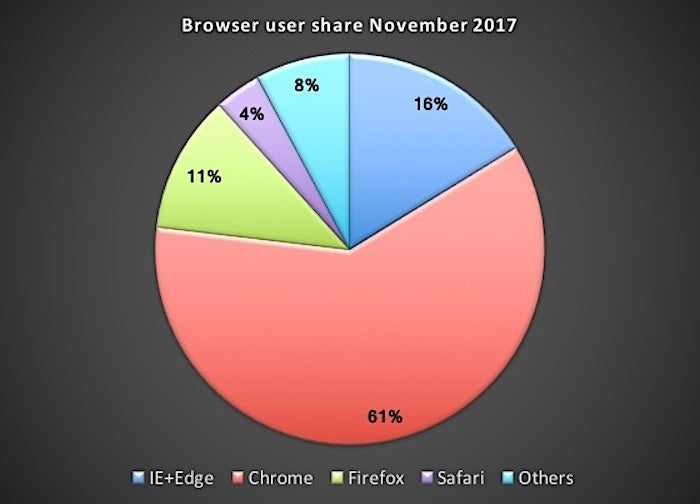
who ran that browser - plummeted by 3.3 percentage points to end
November at 16.3%. The decline was the largest ever for Microsoft's
browsers.
Mozilla's Firefox also stumbled badly last
month, losing nearly 2 of its hard-won percentage points, slipping to
11.4%, its lowest user share since October 2016.
These
numbers, and more importantly the fact that IE+Edge's and Firefox's
numbers sank to such a degree, is striking. But it was as much a data
reset by Net Applications as proof of massive user desertions.
As
it has periodically, Net Applications has reworked how it tracks
browsers, operating systems and other metrics of interest to online
businesses. In a message appended to a refreshed analytics display, Net
Applications explained that it had rewritten its "entire collection and
aggregation infrastructure to address" out-of-whack data.
The
culprit? Bots, said Net Applications. These software-based tools often
are deployed by criminals, who program their automated scripts to mimic
human online behavior, perhaps in an attempt to cash in on an ad click
fraud scam.
"Bots can cause significant skewing of data," admitted Net Applications.
"We have seen situations where traffic from certain large countries is
almost completely bot traffic. In other countries, ad fraudsters
generate traffic that spoofs certain technologies in order to generate
high-value clicks. Or, they heavily favor a particular browser or
platform."
While some may want to blame the large shifts
in browser user share on Net Applications' scouring its data of bot
traffic, that would be the wrong move. "Please note: This dataset is
separate from and replaces the legacy data," the company said, making
clear that it had gone back into past data too, not just November's, and
eradicated the numbers it ascribed to bots.
Under the new methodology, for example, IE+Edge in October was 16%, or 3.6 points lower
than Net Applications called the pair using the older, bots-plagued
data. Using the new-only data, IE+Edge actually edged up (no pun
intended) by about two-tenths of a percentage point. Likewise, Firefox
was at 11.7% in October under the new scheme, but 13.1% under the old.
(Firefox's drop, then, was about three-tenths of a percentage point
during November.)
Assuming that the new methodology
cleaned out all or most of the dodgy bot-driven traffic from Net
Application's data, the bottom line is that the numbers now portray
IE+Edge, and to a lesser extent, Firefox, in less flattering lights.
Microsoft's browsers have deteriorated to a point unthinkable just two
years ago, when they ran on more than half the world's personal
computers. And Firefox's climb back from a near-death experience in 2016
has not been as impressive as the data once showed.
Also of interest were the new data points for Edge and IE calculated against only
Windows personal computers. Because both browsers run only on Windows
devices, it has been possible to surmise their share on that platform
alone. Of all Windows 10 users, just 13.2%, a record low, ran Edge in
November (Edge only runs on Windows 10). As recently as March, Edge's
share of Windows 10 had been around 22%.
IE's share of
18.4% of all Windows PCs was slightly better than Edge's, but like its
successor, IE's November mark was an all-time low. At the start of 2016,
IE's Windows-only share was a more respectable 28.5%.
Bottom
line: Net Applications' scrubbed data painted a picture of Windows 10
users shunning Edge, and IE users renouncing the browser in record
numbers.
Apple's Safari also shed user share last month,
sliding six-tenths of a percentage point to 3.9%. Meanwhile, the king
of the hill, Google's Chrome, ended November with a user share of 60.6%,
up about eight-tenths of a point. It was the first time that Chrome
broke the 60% tape in Net Applications' tracking.
Because
browser share is a zero-sum game, the downgrading of Microsoft's,
Mozilla's and Apple's browsers meant others experienced growth. In Net
Applications' case, the cleaned-up data and revised website listed a
slew of previously-unreported browsers, including several popular
outside the U.S. Among those were QQ, the browser created by Tencent,
China's largest web company (with a user share of 1.8%) and Yandex,
which belongs to the same-named Russian search firm (0.6%). Others now
on Net Applications' list ranged from Opera (1.4%) to Vivaldi (0.1%).
Net
Applications calculates user share by detecting the browser agent
strings of those who visit its clients' websites. It then tallies the
various browsers, accounting for the size of each country's online
population to better estimate share in regions where it lacks large
numbers of analytics customers.
IDG/Data: Net Applications Microsoft's
browsers — Internet Explorer and Edge — were used by just 16% of the
world's online users of personal computers last month, or on about one
in every six systems. The once mighty Microsoft could soon be eclipsed
by Mozilla and that open-source developer's Firefox.


 E/Edge combo and Mozilla's Firefox.
 IDG/Data: Net Applications



No comments:
Post a Comment