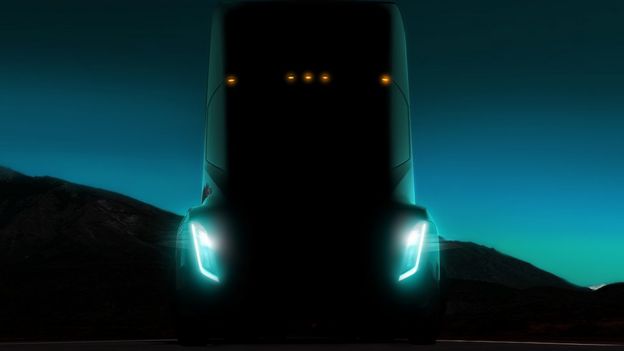
Tesla has unveiled its first electric articulated lorry, designed to challenge diesel trucks as king of the road.The long-anticipated Tesla Semi has a range of 500 miles on a single charge.
Tesla says the vehicle - known in the US as a semi-trailer truck - will go into production in 2019.
Chief
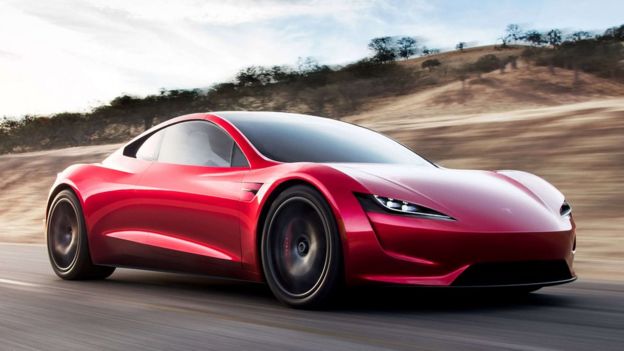
executive Elon Musk also unexpectedly revealed a new Roadster, which he
said would be "the fastest production car ever" made.
The red sports car was driven out of the trailer of the electric lorry during Tesla's presentation on Thursday.
The Roadster will have a range of close to 1,000km (620 miles) on a single charge and will do 0-100mph in 4.2 seconds.
Mr Musk described it as "a hardcore smackdown to gasoline cars".
He
said riding in traditional cars would be like driving "a steam engine
with a side of quiche". The new Roadster becomes available in 2020. The Tesla Semi will achieve 0-60mph in 20 seconds when pulling 36,287kgs (80,000lbs), the maximum allowed on US roads.
Speaking
on stage at Tesla's facility in Los Angeles, chief executive Elon Musk
said: "It's not like any truck that you've ever driven."
However,
the charismatic Mr Musk faces continued pressure from investors and
customers as the firm struggles to meet demand for its Model 3 car.
Model 3 delays
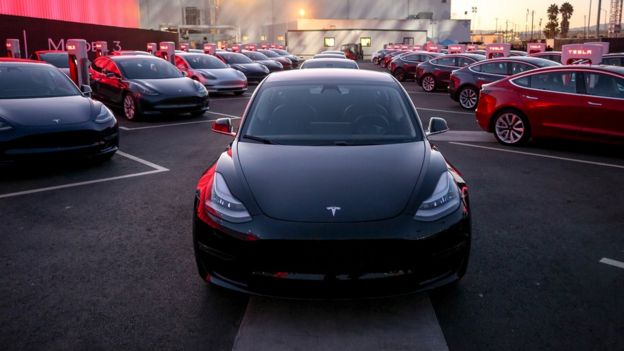
The Model 3 is behind schedule due to factory delays, a situation Mr Musk described recently as “production hell”.
The
46-year-old had been camping at Tesla’s Gigafactory in Reno, Nevada,
to oversee battery production for the new cars. However, while the
company had predicted it would make 1,500 Model 3 cars in the third
quarter of 2017, in reality it only managed 260. Depending on your opinion of Mr Musk, launching a
new truck at this time is either a bold statement of belief in his
technology, and business as usual, or a foolish distraction from Tesla’s
main goal of making its Model 3 a mainstream, affordable car.
There
are elements of the Model 3 in the Tesla Semi. Each of its wheels is
powered by a Model 3 motor, and the cab features two of the touch
screens displays found in the Model 3.
Competitive market
With
Tesla Semi, Mr Musk enters a competitive, demanding market. There are
an estimated 3.5 million truck drivers in the US, the vast majority of
whom drive diesel-powered engines. Tesla will not be able to compete on
diesel’s range, and battery specialists doubt Tesla can produce a
powerful enough battery at a reasonable price.
“A 300-mile-capable battery pack costs about $200,000,” a Carnegie Mellon study concluded.
“Which is much higher than a diesel-powered semi-truck, which costs about $120,000, on average, for the entire vehicle.”
Mr Musk said the Tesla Semi would be able to travel
643km (400 miles) after 30 minutes of charge at one of Tesla's new
mega-chargers.
The cost?
As
for cost, the company said that per mile the Tesla Semi would work out
cheaper than a diesel equivalent when fuel and other maintenance is
taken into consideration - but did not share the cost of an individual
truck.
The Diesel Technology Forum, a non-profit trade group that
promotes the use of diesel, said Tesla’s announcement needed to be
"evaluated in the context of reality”.
"Diesel is the most energy efficient internal combustion engine,” Allen Schaeffer, the forum's executive director.
"It
has achieved dominance as the technology of choice in the trucking
industry over many decades and challenges from many other fuel types.
"Still,
today, diesel offers a unique combination of unmatched features: proven
fuel efficiency, economical operation, power, reliability, durability,
availability, easy access to fuelling and service facilities, and now
near-zero emissions performance."
As well as coming up against
diesel incumbents, Tesla also faces other electric rivals. Concept
electric big rigs have been unveiled by Daimler, Volkswagen and Cummins -
though all fall short on range, and none are currently on the roads.
Where Tesla believes it can bring an added advantage is with on-board safety and comfort.
A
statement from Tesla boasted that “jackknifing is prevented due to the
Semi's onboard sensors that detect instability and react with positive
or negative torque to each wheel while independently actuating all
brakes".
"The surround cameras aid object detection and minimise
blind spots, automatically alerting the driver to safety hazards and
obstacles.
"With Enhanced Autopilot, the Tesla Semi features
Automatic Emergency Braking, Automatic Lane Keeping and Lane Departure
Warning.”
Autopilot is Tesla’s autonomous driving function that
offers several self-driving features, most importantly guiding the
vehicle to stay within the lines on the road, and slowing down in
keeping with traffic up ahead.





No comments:
Post a Comment